


My photos app has been stopping me lately.
Not with anything urgent. Just memories. The kind that surface as a notification on my phone. A photo from three years ago, a face I haven’t seen in a while, a home I used to live in, an event I’d almost forgotten. The app just finds them and puts them in front of me whether I’m ready or not.
Most of them I swipe away without thinking.
But some of them I sit with.
The ones I stop for are usually the same kind. People or pets that are no longer in my life. Old homes. Moments from seasons that are long gone. Those ones don’t get swiped. They get a moment. Sometimes just a breath. Sometimes more.
And lately those pauses have been making me ask a question I haven’t asked in a while:
How do I actually see the past?
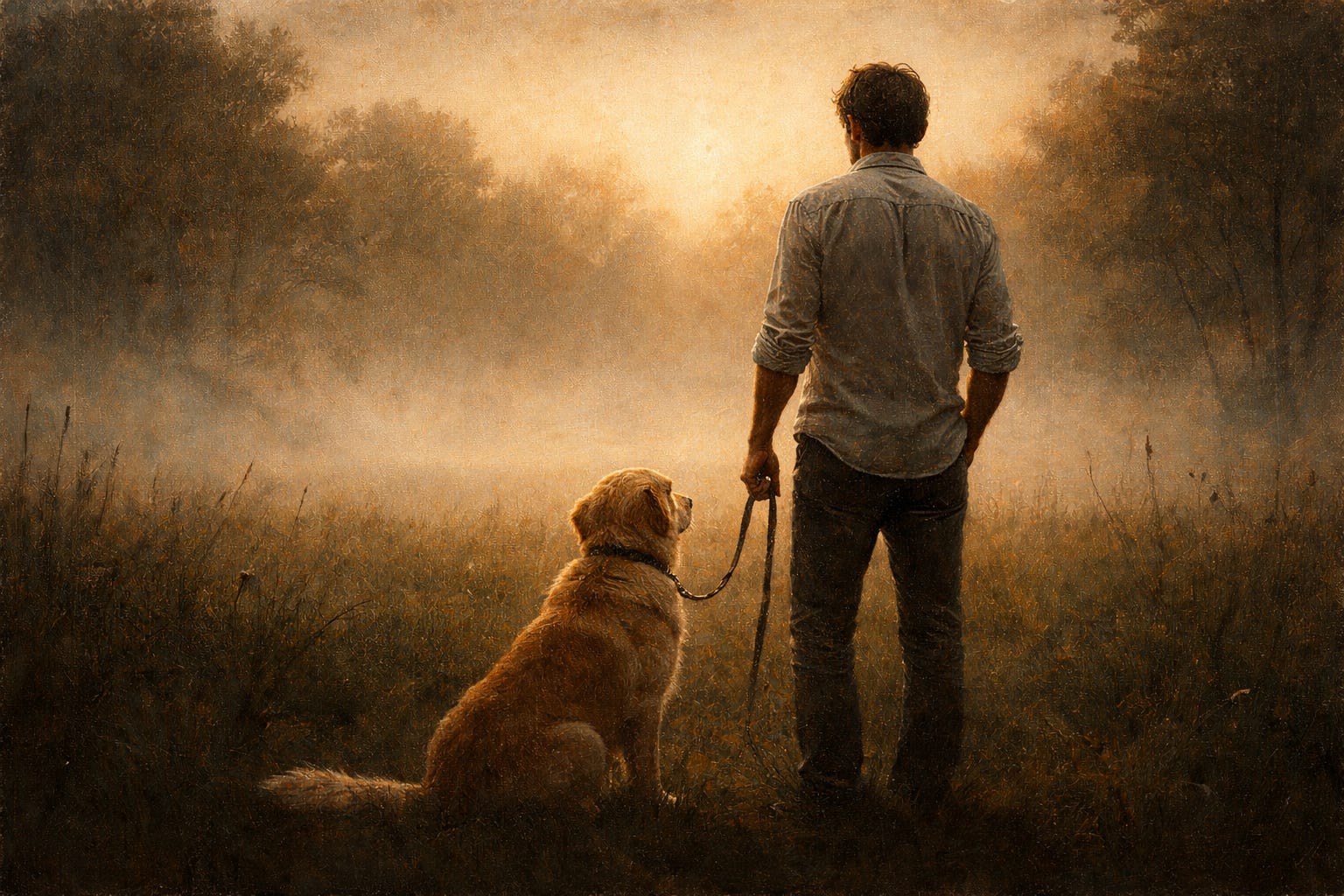
I took my dog out one morning recently. It was early and quiet the way Kansas mornings get, breezy and a little overcast, the sky the color of something that might become rain. I was standing in the grass, feeling the wind on my face and looking up at the sky, and the question surfaced in my mind.
How do I actually see the past?
Seven years have passed since I left home.
Seven years of moving more times than I can count. Swapping careers, building a large social following from scratch, going through a significant weight loss, building a house. Losing some of the closest people in my life. Building a marriage through all of it, my wife and I growing up together in real time, figuring it out as we went.
People tell us we seem older than we are. That the way we talk, the way we carry our stories, feels like more than our age should hold. I understand why they say that. It feels like we’ve lived a full life inside of seven years.
And the strange thing is, I haven’t really sat with any of it.
Life moved so fast and I moved with it. There was always a next thing. A next goal, a next project, a next meeting, a next version of something I was building. You often don’t pause when you’re in motion like that. You just keep going.
But standing in the grass that morning, the breeze moving around me, I realized something had shifted. Things have slowed down a little. And in that quiet, the past was finally asking for some attention.
When I was younger, I lived in the past. I couldn't stop replaying conversations, revisiting moments, turning them over looking for where things went wrong. What I should have said differently?
I spent a lot of time in that space.
I won’t say it was entirely wasted. Somewhere in all that analysis I developed an ability to read people, to notice posture, to catch what someone wasn’t saying, to understand a room. It wasn’t the most efficient way to learn that skill. But it’s where I learned it.
Still, there’s a cost to living in the past that way. You’re constantly trying to will a different outcome from something that’s already finished. And no matter how long you sit with it, you cannot change it.
I know that now in a way I didn’t then.
However, the past looks different to me these days.
The period of life that forced me to continuously be moving and building forced me out of my head and pushed me to take action rather than overthink.
After seven years of momentum, it’s become more like a logbook - something I pull from, reference, learn from, and then set back down.
When a photo surfaces and it’s someone I’ve lost, I don’t swipe it away. I let myself feel it. The past is a place to feel. A place to remember the people who shaped you, who loved you, who left before you were ready. You’re allowed to go there for that. You’re supposed to.
But when I’m dealing with something in the present, a mindset problem, a pattern I keep repeating, a reaction I don’t fully understand, I use the past differently. I go back not to find someone to blame, but to find the source. To understand it. Because understanding something gives you options. Blame just gives you somewhere to point.
“Until you make the unconscious conscious, it will direct your life and you will call it fate.” Carl Jung
That distinction matters more than most people realize.
Here’s the thing about blaming the past, especially blaming the people in it:
We don’t zoom out far enough.
It’s easy to look back at how you were raised and find the things that were wrong. The gaps. The moments that left a mark. And some of those things are real and worth examining.
As a child you start out completely incapable of taking care of yourself. Entirely dependent on someone else to feed you, hold you, keep you alive. And the people who do that for you, they’re just figuring it out too. Making the best decisions they can with what they have, in the circumstances they’re in, shaped by their own pasts they never fully sat with either.
And then one day, if you’re paying attention, you realize the circle closes. The people who once took care of you start to need you to take care of them.
It all comes back around.
That perspective doesn’t erase the hard things. It doesn’t mean everything was fine or excusable. But it makes it harder to stay in resentment when you understand that everyone in the story was just a person trying to navigate their own.
I don’t want to live in the past. I can’t change it and I’ve made peace with that in a way that took longer than I’d like to admit.
But I don’t want to run from it either.
The past is where my progress lives. It’s the only place I can go to see how far I’ve actually come. Not in a self-congratulatory way, but in an honest one. A look at what you’ve survived kind of way. A look at what you’ve built kind of way.
The photos app will keep surfacing memories. Some of them I’ll swipe away.
But some of them I’ll sit with.
And I’m learning that the ones worth sitting with aren’t always the ones that sting the most. Sometimes they’re just the ones that remind you how much of a life you’ve actually lived. How many people you’ve loved. How many versions of yourself you’ve already been.
The past is a reference point, not a residence.
Use it. Learn from it. Feel what it has to offer.
And then come back to today.
Because today is the only place anything can actually be built.